ETHICS IS NOT SELF-CERTIFYING
POWER ISN’T ITS OWN LIMIT

I’m examining ethical concepts in a course on Political Ethics for Social Transformation (Lexington Theological Seminary, Kentucky) in relation to our current political crisis.
When Donald Trump claims—“I do not need international law” and “My own morality. My own mind. It’s the only thing that can stop me”—he is declaring self-authorization. He is placing himself beyond judgment, beyond restraint, beyond accountability. That move is not ethically neutral. It is a theological and moral rupture.
Christian ethics begins with a sober realism about power. It does not assume benevolence. It does not trust intention. From its earliest traditions, Christianity insists that power—especially concentrated power—tends toward self-deception. That is why authority must be constrained by law, by institutions, by covenant, and by the cries of those harmed. The idea that a leader’s inner sense of morality is sufficient restraint is precisely what Christian ethics was formed to resist.
Law exists not because people are wicked, but because even the well-intentioned are fallible. International law, imperfect as it is, represents humanity’s collective refusal to let any single will decide who lives, who suffers, and who is expendable. To dismiss it is not an act of sovereignty; it is an act of moral abandonment—especially of those beyond one’s borders.
Christian ethics judges power not by self-description but by consequence. Scripture does not ask rulers how they felt about their decisions. It asks what happened to the poor, the stranger, the wounded, the displaced. When a morality absolves itself and leaves others to bear the cost, it is not ethics—it is self-exoneration.
The claim to be one’s own moral limit also reveals a failure of moral formation. Ethical maturity requires acknowledging that one’s judgment is partial, shaped by interest, ambition, and fear. Virtue is never self-certified. It is formed in community, tested by critique, and corrected by accountability. A leader who rejects all external judgment does not display strength of character; he displays its absence.
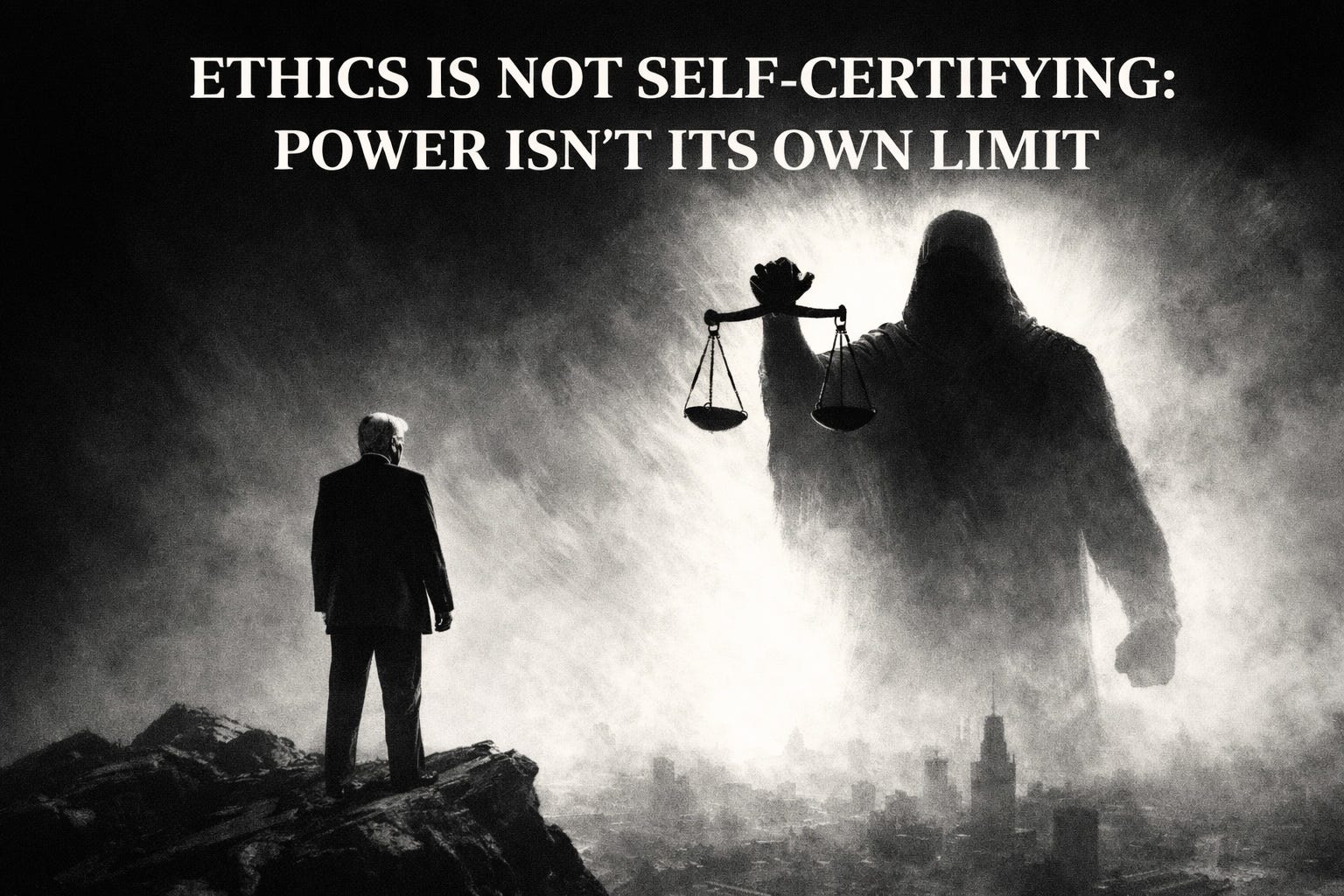
Most dangerously, this posture revives the oldest logic of empire: might becomes right so long as the powerful narrate themselves as righteous. The vulnerable disappear from moral consideration. Suffering becomes collateral. Ethics becomes performance—a spectacle of confidence shielding domination.
Christian political ethics does not negotiate with this logic. It names it. It resists it. It withdraws moral legitimacy from power that refuses restraint. The church’s task is not to bless, manage, or spiritualize rogue authority, but to confront it. Silence is complicity. Neutrality is endorsement.
So let us be clear. When a leader claims to be his own moral limit, ethics does not merely fail—it is executed in public. Power without law is not authority. It is moral idolatry, full stop. And Christian ethics must name it as such, without apology.
ESF-01-09-2026